
NFL Season Structure for UK Bettors: Schedule, Key Dates and Kick-Off Times
 Available in US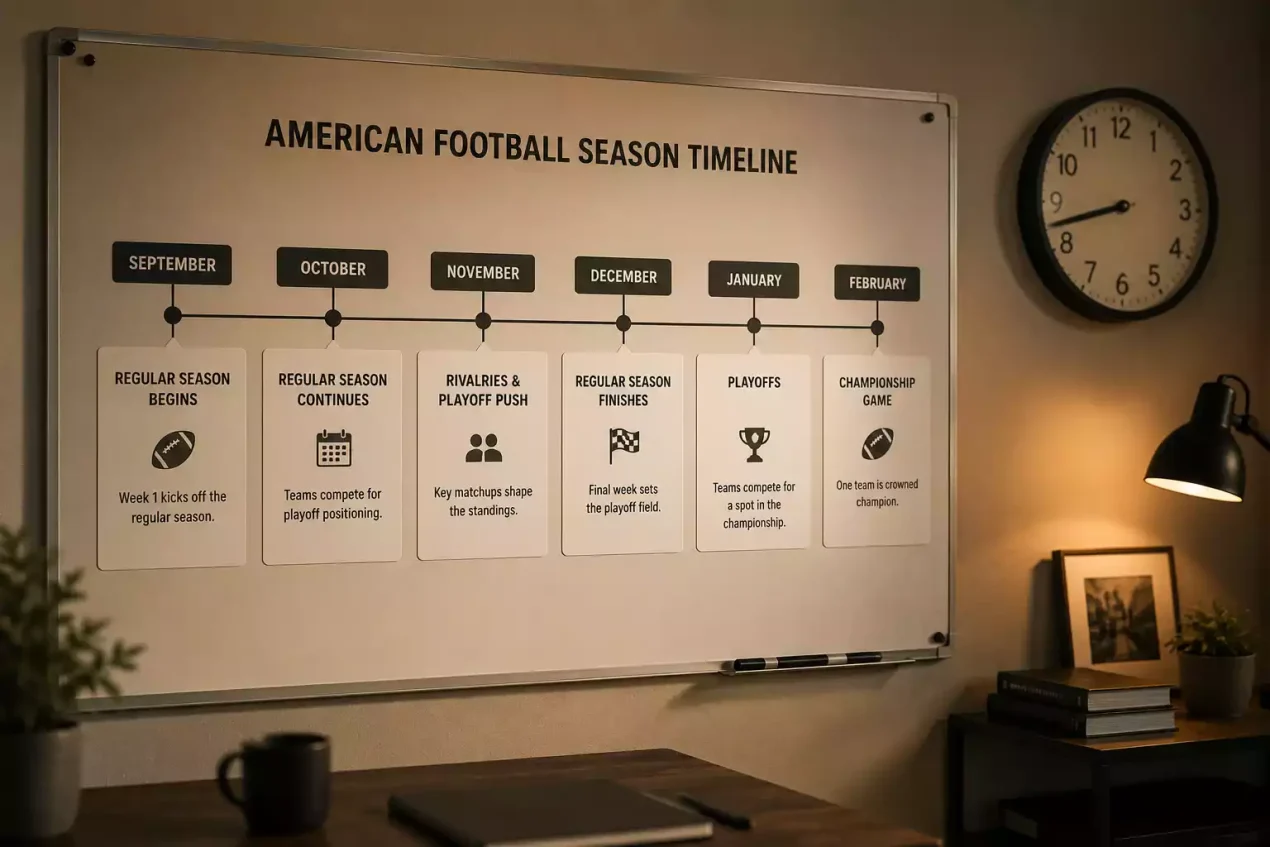
My first full NFL season as a UK bettor, I missed an entire Thursday Night Football game because I assumed it kicked off at the same time as Sunday’s early slate. It did not. I also placed a bet on a team during their bye week, which is the NFL equivalent of backing a Premier League side on a blank gameweek. Embarrassing? Absolutely. But it taught me that the NFL calendar is its own beast, and if you do not understand its rhythms, you will waste money on avoidable mistakes.
The NFL season runs from early September to mid-February, which maps neatly onto the gap between the start of the Premier League season and the Six Nations. For UK punters, this is a feature, not a bug — NFL fills the sporting calendar during weekday evenings and late-night weekend slots that domestic sports leave empty. But the structure is different from anything in European sport, and those differences have direct implications for when, what, and how you bet.
From Pre-Season to Super Bowl: The NFL Calendar Explained
The NFL year begins long before the regular season. The off-season runs from February to July and is dominated by free agency (where players change teams), the NFL Draft (where teams select college players), and organised team activities. Betting markets are thin during this period, limited to futures like the Super Bowl winner and MVP. The prices are wide, the information is speculative, and the off-season is mostly useful for research rather than wagering.
Preseason runs through August, with each team playing three exhibition games. These games have limited betting relevance — starters often play only a quarter or two, and the results say almost nothing about regular-season performance. Some UK sportsbooks offer markets on preseason games, but the odds tend to carry large margins and the analytical tools that work during the regular season (efficiency metrics, injury-adjusted projections) are nearly useless when rosters are in flux and coaches are evaluating fringe players.
The regular season spans 18 weeks, from the first Thursday in September to the first weekend in January. Each team plays 17 games with one bye week (a scheduled week off). The 18-week schedule means that on any given Sunday, at least two teams are idle — a detail that trips up punters who build accumulators without checking the bye-week schedule. The regular season is the bread and butter of NFL betting: spreads, totals, props, and moneylines are available in depth for every game, and the data generated each week feeds directly into the following week’s analysis.
The NFL staged a record seven international games in 2025: three in London, plus fixtures in Dublin, Berlin, Madrid, and São Paulo. Commissioner Roger Goodell described the international push as the greatest opportunity for growth, with an ambition to reach 16 international games per season within five years. For UK bettors, the London games are the most accessible NFL events of the year — played at convenient times, with extensive local media coverage, and often accompanied by promotional betting offers from UK sportsbooks.
The postseason begins in mid-January with Wild Card weekend (six games), followed by the Divisional round (four games), the Conference Championships (two games), and the Super Bowl in mid-February. The entire playoff bracket takes four weeks, and each round reduces the field by half. Betting volumes escalate dramatically through each round, with the Super Bowl alone generating an estimated $1.76 billion in legal US wagers in 2026.
NFL Kick-Off Times in UK Time Zones: When Games Air
If you are betting on NFL from the UK, your weekly schedule revolves around five kick-off slots, and knowing them by heart saves the scramble of checking each week.
The early Sunday window kicks off at 6pm UK time (GMT from November to March, BST from March to October). This is the busiest slot, with six to eight games starting simultaneously. It is the most important window for UK punters because it falls at a sociable hour — you can watch on the sofa, bet from your phone, and still be in bed before midnight. Most of your weekly NFL analysis should target this slot.
The late Sunday window starts at 9.05pm or 9.25pm UK time, with two to four games. These are the premium matchups that the NFL schedules for its main US broadcast windows. If you are only watching one game on a Sunday, it will often be from this slot.
Sunday Night Football kicks off at 1.20am UK time (Monday morning). This is the marquee prime-time game of the week, typically featuring the league’s best teams. Betting on this game from the UK requires either a late night or a pre-placed bet — live betting at 2am is for the committed only.
Thursday Night Football starts at 1.15am UK time (Friday morning). Same late-night constraint applies. Monday Night Football kicks off at 1.15am UK time (Tuesday morning). These midweek games are challenging for UK punters who need to be up for work the next day, but they extend the NFL betting calendar beyond the Sunday window.
Sky Sports holds the primary UK broadcast rights for NFL, having signed a new three-year agreement extending a partnership of more than 30 years. Sky typically broadcasts several games per week, with the Sunday early and late windows receiving the most coverage. Selected games also appear on free-to-air channels, particularly during the playoffs and Super Bowl. If you are planning to bet live, knowing which games you can actually watch is essential — live betting without a visual feed is guesswork.
How Bye Weeks and Scheduling Quirks Affect Betting Markets
Every NFL team gets one bye week during the regular season — a week off with no game. Bye weeks are scattered across Weeks 5-14, and they create two distinct betting angles.
First, the post-bye advantage. Teams coming off a bye week have had two weeks to prepare for their next opponent, heal minor injuries, and install new game-plan elements. The historical data shows a modest but consistent edge for post-bye teams against the spread, particularly when their opponent is coming off a short week (Thursday to Sunday) or a physically gruelling game. This edge is well-known enough that sportsbooks partially price it in, but the adjustment is often insufficient, especially for mid-tier teams that do not attract heavy public betting.
Second, the pre-bye letdown. Some teams, particularly those with losing records, show a motivational dip in the game immediately before their bye week. The theory is straightforward: players looking forward to a week off may not bring peak intensity to a game that feels less urgent. The data on this is softer than the post-bye advantage, but it is worth flagging as a factor when you are evaluating a game where one team is heading into its bye.
Scheduling quirks extend beyond bye weeks. The NFL schedules “flexed” games — moving late-season matchups into prime-time slots based on competitive relevance. A game originally scheduled for the early Sunday window might be flexed to Sunday Night Football if both teams are in playoff contention. This affects betting because prime-time games attract more public money, which can move lines in directions that regular-window games would not experience. If you have placed an early-week bet on a game that subsequently gets flexed, the line may move against you as public money floods in.
One more calendar quirk worth knowing: the NFL’s annual schedule release in May generates its own wave of futures betting activity. Sharp bettors scan the schedule for strength-of-schedule advantages, rest advantages (teams with early bye weeks face different challenges than teams with late byes), and travel burdens (West Coast teams with multiple East Coast road trips). This pre-season schedule analysis is a niche pursuit, but for punters who enjoy the research phase, it provides an analytical edge that starts paying off months before the season begins. For a deeper look at how the London games fit into this calendar, that guide covers the International Series in full detail.
Your Season Starts When You Understand the Calendar
The NFL season is not a formless block of betting opportunities — it is a structured sequence with peaks, troughs, and inflection points. Knowing when games kick off in UK time, which teams are on bye, when the playoffs begin, and how the schedule shapes the market is not glamorous analytical work. But it is the foundation that every other piece of your NFL betting strategy sits on. Get the calendar right, and everything else becomes easier.
What time do NFL Sunday Night and Monday Night games start in the UK?
Sunday Night Football kicks off at 1.20am UK time (technically Monday morning). Monday Night Football starts at 1.15am UK time (technically Tuesday morning). Both are late-night viewing for UK audiences. If you plan to bet live on these games, pre-set your selections during the evening and use auto cash out features if available, or commit to a late night.
Does the NFL preseason offer betting markets at UK bookmakers?
Some UK sportsbooks offer markets on NFL preseason games, but coverage is limited compared to the regular season. Market depth is shallow, margins are wide, and the analytical value of preseason results is low because teams rest key players and use the games to evaluate roster fringe candidates. Most serious NFL bettors skip preseason betting entirely and wait for the regular-season opener in September.
This material was created by the GridPunt team.
Related posts

NFL Betting Market Outlook for UK Punters: Trends Shaping 2026 and Beyond

NFL Betting Mistakes to Avoid: Errors That Cost UK Punters Money