US vs UK NFL Betting: How the Two Markets Compare for Punters
 Available in US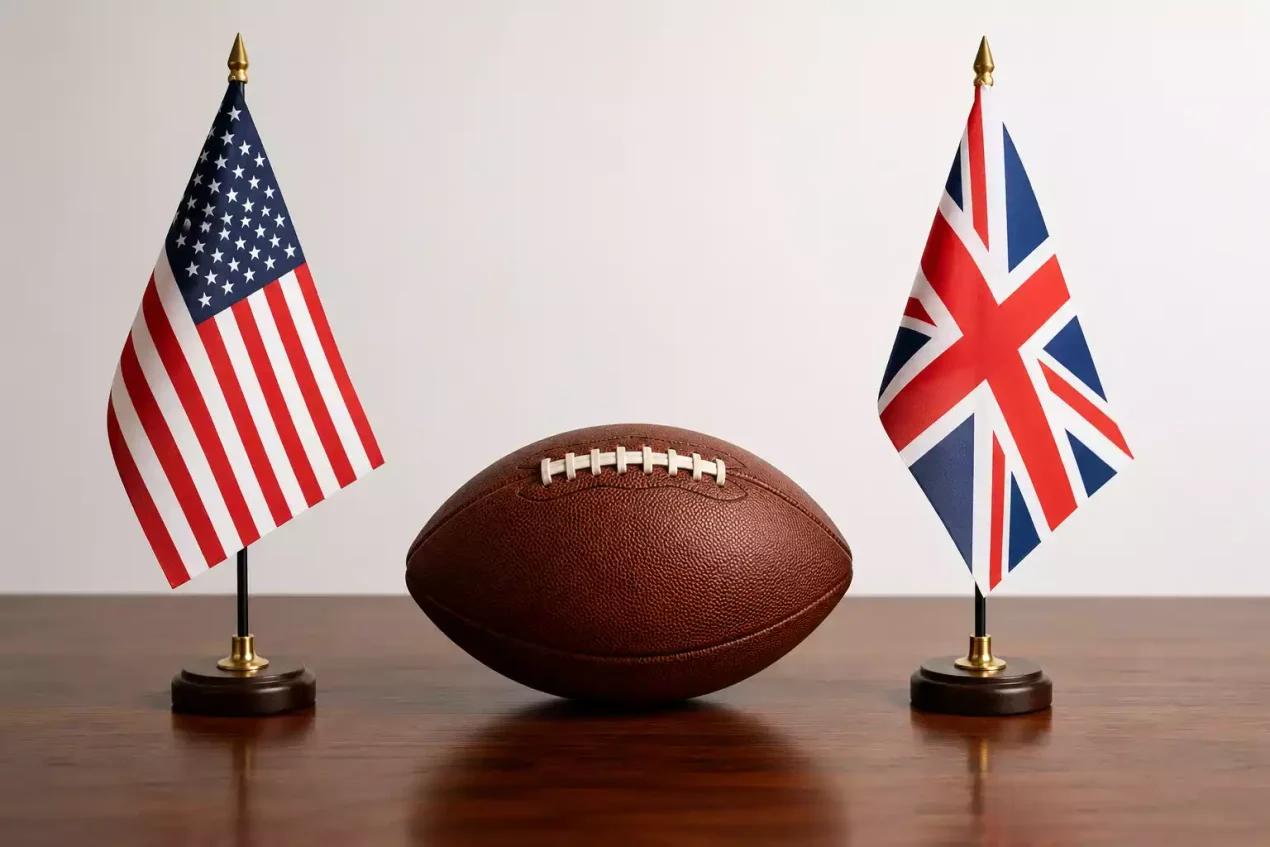
The United States and the United Kingdom both host massive, regulated sports betting markets. Both serve millions of active bettors. Both offer NFL as a core product. But the two markets evolved under different legal frameworks, different cultural traditions, and different economic structures — and the result is two betting experiences that share the same sport but feel fundamentally different. Understanding those differences gives UK punters a clearer picture of what they have, what they lack, and what American analytical content can (and cannot) teach them about NFL wagering.
Market Size: $167 Billion US Handle vs GBP 2.5 Billion UK GGY
The scale disparity is enormous. Total US sports betting handle reached $166.94 billion in 2025, an 11% increase year over year. That figure represents the total amount of money wagered — every dollar placed on every bet at every legal sportsbook across the country. The UK sports betting market, measured differently, generates approximately GBP 2.48 billion in annual gross gambling yield — the amount retained by operators after paying out winning bets.
These two metrics are not directly comparable. Handle is total wagered; GGY is revenue retained. The US market’s GGY — the money sportsbooks actually keep — was $16.96 billion in 2025, which gives a rough hold percentage of about 10%. But even adjusting for the different metrics, the US market dwarfs the UK’s in absolute size, driven by a population five times larger, the cultural centrality of sports betting in American life (22% of US adults held an active sportsbook account in early 2025), and the explosive post-legalisation growth that began in 2018.
For NFL specifically, the gap is even wider. The American Gaming Association estimated $30 billion in legal NFL wagers during the 2025 season. NFL is the single largest sport by betting volume in the US. In the UK, NFL betting is a growing but still secondary category behind football, horse racing, and tennis. The global sports betting market — projected at $125.12 billion in 2026 — shows that the overall industry is expanding, but the US currently drives a disproportionate share of that growth.
What does this mean for UK punters? Primarily, it means the US market is more liquid. More money flowing through NFL lines makes US odds more efficient — sharper, harder to beat. UK NFL odds are priced partly off those US lines, but the smaller UK volume means there is more room for pricing discrepancies between operators. The flip side is that UK sportsbooks cannot always match the market depth that US operators offer, particularly on player props and exotic bet types where the US volume justifies tighter margins.
Regulation at a Glance: State-by-State vs Single National Authority
The regulatory contrast is stark. The UK operates under a single national framework administered by the UK Gambling Commission. Every licensed operator follows the same rules, every punter in Great Britain is protected by the same consumer safeguards, and enforcement is centralised. Whether you live in London, Manchester, or Edinburgh, your rights and protections as a bettor are identical.
The US operates under a fragmented state-by-state system. Since the Supreme Court struck down the federal ban on sports betting in 2018, individual states have legalised and regulated betting on their own terms. By early 2025, 38 states plus Washington DC had legalised sports betting in some form, but the rules vary dramatically. Tax rates, permitted bet types, operator licensing requirements, and consumer protections differ from state to state. AGA President Bill Miller noted that the industry’s record performance in 2025 reinforced the principle that sports betting belongs under state and tribal regulation, framing the fragmented system as a feature rather than a bug.
For UK punters, the practical impact is straightforward: you cannot use American sportsbooks. US operators are geo-restricted — you must be physically present in a state where sports betting is legal to place a bet. DraftKings, FanDuel, BetMGM, and Caesars are household names in the US but are not available to UK customers in their American form. Some of these brands operate or have operated UK-facing products under separate UKGC licences, but the product, pricing, and promotional structure are entirely different from their US counterparts.
The UK’s single-regulator model has advantages: consistent consumer protection, standardised dispute resolution, and a unified self-exclusion scheme (GamStop) that covers all licensed operators. The US model’s advantage is competition — dozens of operators competing aggressively for market share in each state, driving promotional spending and odds quality to levels that the more mature UK market rarely matches. Among men aged 18-49 in the US, 48% held an active sportsbook account in early 2025 — a penetration rate that reflects the intensity of operator competition for that demographic.
Cultural Differences: Odds, Terminology and Betting Style
Beyond market structure and regulation, the day-to-day experience of NFL betting differs culturally between the two countries in ways that affect how you consume information and analyse markets.
Odds format is the most visible difference. US sportsbooks use American odds (+150, -200). UK sportsbooks default to fractional (3/2, 1/2) with decimal as an option. The underlying probabilities are identical, but the format shapes how bettors think about risk and reward. American odds foreground the concept of “risk vs reward relative to $100”, which naturally leads to thinking in units. UK fractional odds foreground the ratio of profit to stake, which aligns with the traditional bookmaking culture of calculating returns mentally.
Terminology diverges more than most UK punters expect. Parlays versus accumulators, juice versus overround, chalk versus favourite — the vocabulary is different enough that reading American NFL analysis requires a mental translation layer. This translation barrier keeps some UK punters from engaging with US analytical content, which is a missed opportunity: the depth and quality of publicly available NFL analysis in the US is unmatched in any other sport.
Betting culture also differs in emphasis. US NFL betting is heavily spread-focused — the point spread is the default bet type, and public discourse centres on “picking against the spread” (ATS). UK betting culture, rooted in horse racing and football, is more comfortable with outright winner markets and accumulators. The result is that UK punters sometimes overlook the spread as a primary NFL bet type, gravitating towards the moneyline or multi-leg accas when the spread might offer better value. For a deeper look at how the UK’s tax-free status on betting winnings compares to the US obligation, the tax guide covers the full picture.
Two Markets, One Sport, Different Edges
The US market is bigger, more liquid, and more efficient. The UK market is more consistently regulated, tax-free for punters, and offers pricing discrepancies that the larger US market has already arbitraged away. Neither market is objectively better for the bettor — they are different environments that reward different approaches. The UK punter who understands both systems, uses American analytical resources for their NFL insights, and exploits the UK market’s structural advantages — tax-free winnings, operator competition for a growing NFL audience, and the occasional soft line on a secondary sport — has a clearer path to sustainable NFL betting than someone who engages with only one side of the Atlantic.
Can UK punters use American sportsbooks like DraftKings or FanDuel?
No. US sportsbooks are geo-restricted and require you to be physically present in a state where sports betting is legal. Some US brands operate UK-facing products under separate UKGC licences, but these are different platforms with different pricing, promotions, and product ranges. UK punters must use UKGC-licensed sportsbooks for legal NFL betting.
Are US NFL odds generally sharper than UK bookmaker prices?
On core markets like the spread and moneyline, US odds tend to be more efficient because of the significantly higher betting volume. The more money that flows through a line, the closer it moves to the true probability. UK sportsbooks price NFL partially off US lines but may have wider margins, particularly on player props and niche markets. This means UK punters face a slightly less efficient market — which is both a disadvantage (wider margins) and an opportunity (more mispriced lines to exploit).
This material was created by the GridPunt team.
Related posts

NFL Betting Market Outlook for UK Punters: Trends Shaping 2026 and Beyond

NFL Betting Mistakes to Avoid: Errors That Cost UK Punters Money