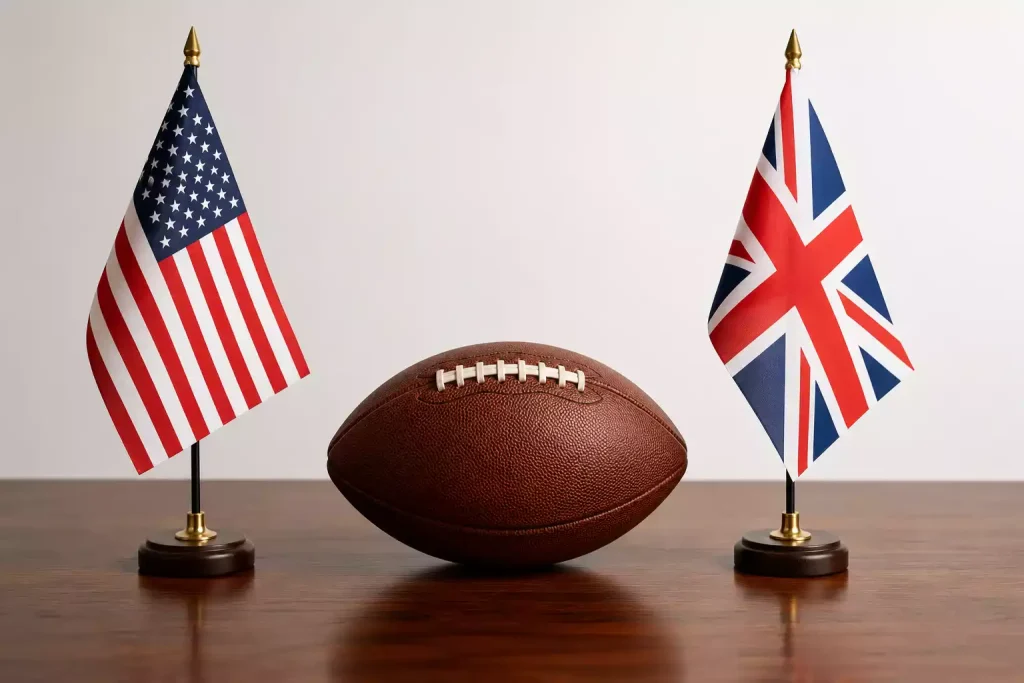
NFL Spread Betting in the UK: How Point Spreads Work and When to Back Them
 Available in US
I still remember the first NFL spread I ever placed from a UK bookmaker. It was a Thursday Night Football game — Broncos at Cardinals, Denver favoured by 3.5 — and I spent twenty minutes trying to figure out why the odds on both sides looked almost identical. Coming from years of Premier League match betting, where the favourite sits at short odds and the underdog stretches out to 5/1 or longer, NFL spread betting felt like a different language entirely. That confusion cost me about six months of clumsy wagers before the maths finally clicked.
Point spread betting is the dominant way Americans wager on the NFL. The point spread — or “handicap” as most UK bookmakers label it — accounts for roughly 61% of all NFL wagers placed in the United States, outpacing moneyline and totals by a wide margin. And it is the single bet type that separates punters who treat NFL betting as a coin flip from those who build a genuine edge across an 18-week season. In this guide, I am going to break down exactly how spreads work, how to read them in formats you recognise, and which data-driven strategies I have used to sharpen my own spread bets over the past decade-plus of covering NFL wagering.
What Is an NFL Point Spread?
Picture two teams about to kick off on a Sunday afternoon. One is a perennial playoff contender, the other is stuck in a rebuilding year. If you simply offered “who wins?” as the only market, nearly everyone would pile onto the favourite, the bookmaker would face massive one-sided liability, and the odds on the underdog would need to stretch to absurd levels to balance the book. The point spread solves this problem by creating a virtual margin of victory.
When a bookmaker sets the Kansas City Chiefs at -6.5 against the Jacksonville Jaguars, they are saying: “Kansas City must win by 7 or more points for a spread bet on the Chiefs to pay out.” Conversely, backing Jacksonville at +6.5 means the Jaguars can lose by up to 6 points and your bet still wins. The spread erases the talent gap on paper and turns every game into something close to a 50/50 proposition — which is precisely why both sides of a spread are typically priced at near-identical odds, usually around 10/11 in fractional terms.
The half-point matters enormously. You will rarely see a spread at a whole number like -7.0 at UK bookmakers, because a whole number creates the possibility of a “push” — the favourite wins by exactly the spread number, and all bets are voided. Half-point spreads eliminate pushes entirely. One side wins, one side loses, no ambiguity. When you do encounter a whole-number spread, the bookmaker’s rules page will tell you whether pushes result in a void or a loss. Check before you stake.
The beauty of spread betting — and the reason I gravitated toward it after years of football accumulators — is that it forces you to think about margins rather than outcomes. It is not enough to know that the Buffalo Bills will beat the New England Patriots. You need a view on whether Buffalo wins by a field goal or a blowout. That distinction is where analysis earns its keep, and where lazy bettors lose theirs.
One concept worth nailing down early: the spread is not a prediction. It is a market price — a number designed to attract equal money on both sides. The opening line reflects the bookmaker’s power ratings and early sharp action, but once the market opens, the spread moves based on where the money flows. A line that opens at -3 and closes at -4.5 tells you a story about how the betting public and professional bettors have assessed the matchup over the course of the week.
Why UK Bookmakers Call It a Handicap
If you have ever placed a handicap bet on a Premier League match — say, Manchester City -1 — you already understand the core mechanic. The NFL point spread is the same concept wearing a different jersey. UK bookmakers almost universally list it under “handicap” in their American football sections, while American sportsbooks call it the “spread” or “line.” The terminology differs, but the bet settles identically: the handicap is applied to the final score, and the adjusted result determines whether your selection wins. For a deeper comparison of how UK handicap display differs from the American format and when alternative lines offer better value, I have written a dedicated breakdown in the NFL handicap betting guide.
How NFL Spreads Are Set and Why Lines Move
A colleague once asked me how bookmakers arrive at a number like -7.5 rather than -6.5 or -8.5. The honest answer is that the process involves far more art than most punters assume. Opening lines typically emerge from a combination of the bookmaker’s internal power ratings — proprietary models that weight factors such as offensive and defensive efficiency, home-field advantage, injury reports, and rest days — plus early input from a handful of sharp bettors whose opinions the market respects. In the US market alone, legal NFL wagering reached $30 billion in the 2025 season, so the financial incentive to get these numbers right is immense.
Once the opening line is released, the spread becomes a living thing. Three forces push it around before kickoff. First, sharp money: professional bettors who have built their own models and strike early when they spot a discrepancy between their number and the market number. A wave of sharp action on one side can move a line by a full point within hours. Second, public money: casual bettors who tend to favour popular teams, home favourites, and teams coming off a big win. Public money usually arrives later in the week, especially on Fridays and Saturdays. Third, information: a starting quarterback downgraded to “out” on Friday afternoon can shift a spread by 2 to 4 points in minutes.
Tracking line movement gives you a window into how the market is thinking. I use a simple discipline: record the opening line when it appears on Sunday night or Monday morning, then check the closing line just before kickoff. If the line has moved toward the side I was considering, I know the market agrees with my read — but I have also lost the best price. If the line has moved away from my side, I might be getting better value, but I need to ask why the market disagrees. Neither scenario guarantees a win. Both sharpen your thinking.
One practical note for UK punters: most major UK bookmakers post NFL lines later than their American counterparts. You might see opening numbers on a US sportsbook by Sunday evening, but a UK operator may not release them until Monday or Tuesday. If you want access to the earliest lines, keep an eye on the US market and have your UK account ready to act when your bookmaker catches up.
Weather is another factor that moves NFL spreads in ways Premier League bettors rarely encounter. An outdoor game in Green Bay in December, with wind chill below minus ten, affects passing games dramatically and tends to compress totals and spreads. Wind above 15 mph suppresses deep passing accuracy. Rain creates fumble risk and slows offensive tempo. None of this happens in a temperature-controlled stadium, so always check the venue before you assess a spread. The global sports betting market, now valued at over $125 billion in 2026, runs on exactly this kind of granular detail — and the punters who ignore it are the ones funding the edge for those who don’t.
Reading Spread Odds in Fractional and Decimal Formats
The first time I showed an American friend my UK betting slip, he stared at “10/11” for a solid ten seconds before asking what it meant. Odds formats are one of those things that feel obvious once you know them and utterly baffling until you do. Since you are placing spread bets at UK bookmakers, you will encounter fractional odds by default, with the option to switch to decimal in your account settings. Let me walk through both — and throw in the American format so you can follow discussion on US podcasts without reaching for a calculator.
Fractional odds show your profit relative to your stake. When a spread bet is priced at 10/11, you are being told: for every 11 pounds you stake, you win 10 pounds profit, plus your 11-pound stake back. So a 22-pound bet at 10/11 returns 42 pounds total — 20 pounds profit plus the original 22. The “standard” price for a spread side is 10/11, which implies an overround of roughly 4.5% across both sides of the market. That margin is how the bookmaker earns.
Decimal odds express the same thing as a multiplier. 10/11 fractional converts to approximately 1.91 decimal. You take your stake, multiply by 1.91, and that is your total return. A 22-pound stake at 1.91 returns 42.02 pounds. Decimal is popular across Europe and increasingly in the UK, and many punters prefer it because comparing prices across bookmakers is faster — you are just looking for the highest number.
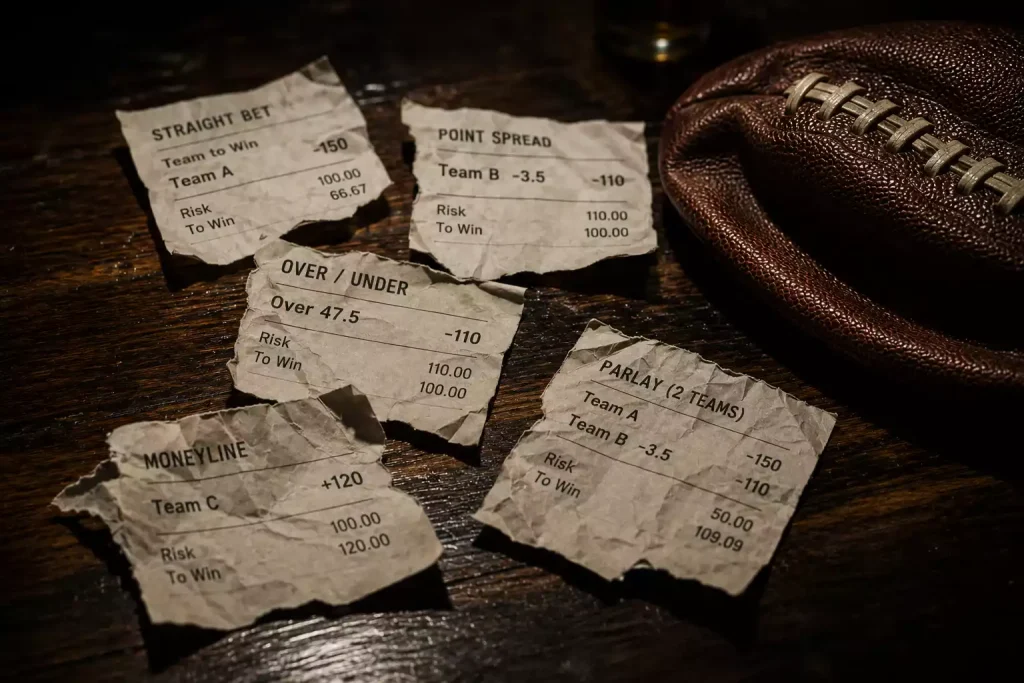
American odds use plus and minus signs. The “standard” spread price in the US is -110, which means you must risk 110 dollars to win 100 dollars. That is mathematically equivalent to 10/11 fractional or 1.91 decimal. When you see an NFL podcast host say “I got the Chiefs minus seven at minus one-oh-five,” he is telling you he got a slightly better price than standard — equivalent to about 20/21 or 1.95 decimal. These fractional differences look small on a single bet. Across hundreds of bets over a season, they compound into a meaningful impact on your return.
A practical comparison helps make this concrete. Suppose the Philadelphia Eagles are -3.5 against the Dallas Cowboys. Your UK bookmaker prices Eagles -3.5 at 5/6 (1.83 decimal, -120 American). The same bookmaker prices Cowboys +3.5 at evens (2.00 decimal, +100 American). The asymmetry tells you the bookmaker has shaded the line toward the Eagles side — they expect more public money on Philadelphia and have adjusted the price to compensate. If your analysis says the Eagles should be -3.5 at closer to 10/11, the Cowboys side at evens might be the value play. Reading the price, not just the spread number, is half the battle.
One habit I have built over the years: I keep my default display in decimal format for comparison shopping, then switch to fractional when I want to calculate returns quickly in my head. It takes about a week to get comfortable toggling between the two. Do not let format anxiety stop you from placing a spread bet — it is genuinely the same bet regardless of how the number is displayed.
Three Spread Betting Strategies That Use Real NFL Data
Theory is fine. Making money from it is another matter entirely. Over twelve years of tracking my own NFL bets, I have settled on three spread strategies that consistently outperform my ad hoc punts. None of them requires a maths degree — they require patience, a spreadsheet, and the willingness to let data override your gut feeling about which team “should” win.
Bill Miller, the head of the American Gaming Association, put it well when he said that legal sports betting enhances the enjoyment and friendly competition that make NFL traditions special. He is right, but enjoyment and discipline are not mutually exclusive. Here is how I approach the three frameworks.
Strategy One: Fade the Public on Primetime Games
Primetime NFL games — Thursday Night Football, Sunday Night Football, Monday Night Football — attract the most casual betting volume. Casual bettors tend to back the more popular team, the home team, or the team with the better record, without considering whether the spread has already priced in those factors. Over the past five seasons, I have tracked closing line movement on primetime games and found that the less popular side — the team receiving fewer than 35% of public bets — has covered the spread at a clip above 53%. That does not sound dramatic, but in spread betting, anything consistently above 52.4% is profitable against standard 10/11 juice.
The execution is straightforward. Early in the week, identify primetime games where public sentiment heavily favours one side. Wait for the line to move toward the public side — which it usually does between Thursday and kickoff — then take the other side at the inflated number. You are not betting against the favourite because you think the underdog wins. You are betting that the public has pushed the spread past its true value.
Strategy Two: Divisional Dogs in the Second Half of the Season
Divisional matchups in the NFL are different beasts. Teams in the same division face each other twice a year, and the coaching staffs spend months game-planning specifically for those opponents. The result: divisional underdogs outperform their spread expectations more frequently than non-divisional underdogs, particularly from Week 10 onward when playoff positioning adds an extra layer of motivation. My records show that divisional dogs of 3 to 7 points have covered at around 55% from Week 10 through the regular season finale over the past six years.
Why does this work? Familiarity compresses talent gaps. A weaker team that has already played the divisional favourite once that season knows exactly what offensive scheme to expect, which defensive tendencies to exploit, and where the matchup vulnerabilities lie. That knowledge does not erase a 6-point talent deficit, but it narrows it — often enough to slip under the spread.
Strategy Three: Rest-Advantage Spreads
NFL teams play once a week, and the schedule is not always balanced. A team coming off a Thursday night game gets ten days of rest before their next Sunday fixture. A team playing on Monday night has only six days before the following Sunday. Rest advantages of four or more days have historically correlated with stronger spread performance — the rested team is healthier, better prepared, and physically fresher. I filter for matchups where one team has a rest advantage of at least three days and the spread has not fully adjusted for it. In my tracking, these situations have delivered a 54% cover rate against the spread.
The UK sports betting market generates roughly 2.48 billion pounds in annual gross gambling yield, and a meaningful portion of that comes from punters who never consider factors like rest days or divisional familiarity. That is what creates the edge for those who do.
Key Numbers in NFL Spreads: 3, 7 and Why They Matter
NFL scores cluster around certain margins of victory, and two numbers dominate everything else: 3 and 7. A field goal is worth 3 points. A touchdown with extra point is worth 7. These are the most common final margins in NFL history, and they create pricing anomalies around spreads that cross those thresholds.
The difference between -2.5 and -3.5 is not “one point of spread.” It is the difference between needing a team to win by a field goal versus needing them to win by more than a field goal — and roughly 15% of all NFL games are decided by exactly 3 points. Similarly, the jump from -6.5 to -7.5 crosses the touchdown threshold. About 9% of games land on exactly 7. If you can buy a half-point to move from -3.5 to -3 or from -7.5 to -7, the mathematical gain is significant — far more significant than buying a half-point around, say, -5 or -9, where games land far less frequently.
Some UK bookmakers offer alternative spreads that let you adjust the line in exchange for different odds. If you see your side at -3.5 and the bookmaker offers -2.5 at a shorter price, the trade-off is worth examining. You are paying for the right to win on games decided by exactly 3 points, and that payment can represent positive expected value if your model gives the favourite a reasonable chance of winning by a field goal.
I keep a reference table pinned to my desk: the ten most common NFL final margins, ranked by frequency. 3, 7, 10, 6, 4, 14, 1, 17, 8, 2 — that sequence has barely changed over two decades. Knowing it turns spread shopping from guesswork into arithmetic.
Common Spread Betting Mistakes UK Punters Make
Every spread bettor I know — myself included — has a catalogue of expensive lessons. The mistakes cluster into a few predictable patterns, and catching yourself before you repeat them is genuinely more valuable than finding one extra edge.
The most common error is backing the favourite every week because “good teams win.” They do — but spread betting is not about winning, it is about winning by enough. Over a full NFL season, favourites cover the spread roughly 48-50% of the time. That means blindly backing favourites is a slow bleed against the 10/11 juice. I fell into this trap during my first two seasons of spread betting and convinced myself I was just “unlucky.” I was not. I was ignoring what the spread had already priced in.
Recency bias is equally destructive. A team that just lost 38-10 looks terrible, and your instinct is to fade them the following week. But NFL results are far more volatile week-to-week than Premier League results. A team that gets blown out on Sunday can win outright the next Sunday against a similar opponent, because the blowout was driven by three turnovers and a kick return — events that regress sharply toward the mean. Before you react to last week’s score, check the underlying efficiency metrics. If a team lost by 28 but moved the ball efficiently between the twenties, the scoreboard is lying to you.
Ignoring the closing line is a mistake I see constantly. Many UK punters place their spread bets on Saturday evening, pat themselves on the back, and never check what the line does on Sunday morning. But sharp money arrives late, and the closing line is the most accurate predictor of the true probability. If you bet Eagles -3 on Friday and the line closes at Eagles -1, the market is telling you the game is closer than you thought. Track your bets against the closing line, not just against the result. If you are consistently betting on the wrong side of closing line movement, your handicapping needs work, regardless of short-term results.
Finally, staking too much per spread bet erodes your bankroll faster than bad picks do. I allocate 1-2% of my NFL bankroll per spread wager, which lets me absorb the inevitable losing streaks without panic. Punters who stake 5-10% per bet are one bad week away from chasing losses, and chasing losses in spread betting is a death spiral.
NFL Spread Betting: Your Questions
What happens if the spread lands exactly on the number?
If the final margin matches the spread exactly — for example, a team favoured by 7 wins by exactly 7 — the bet is typically voided and your stake returned. This is called a ‘push.’ Most UK bookmakers use half-point spreads to avoid pushes entirely, but if you encounter a whole-number spread, check the operator’s specific settlement rules before placing your wager.
Can I combine spread bets in an accumulator?
Yes. Most UK bookmakers allow NFL spread selections as legs in an accumulator. Each spread bet must win individually for the acca to pay out. Combining spreads across multiple games amplifies potential returns but also multiplies the difficulty, since each leg is close to a 50/50 proposition after the bookmaker’s margin.
How do UK bookmakers display NFL spreads compared to American sportsbooks?
UK bookmakers label the spread as a ‘handicap’ and default to fractional or decimal odds. American sportsbooks use plus/minus spreads with American odds like -110. The underlying bet is identical — only the presentation differs. You can switch your UK account to decimal format for easier cross-market comparison.
Do NFL spread lines tighten or widen during the preseason?
Preseason spreads tend to be wider than regular-season spreads because starters play limited snaps and roster evaluations are ongoing. The margin of uncertainty is higher, and bookmakers compensate by offering less competitive odds and smaller maximum stakes on preseason games.
This material was created by the GridPunt team.
Related posts

NFL Betting Market Outlook for UK Punters: Trends Shaping 2026 and Beyond
NFL Betting Mistakes to Avoid: Errors That Cost UK Punters Money