
NFL London Games Betting: How the International Series Changes the Odds
 Available in US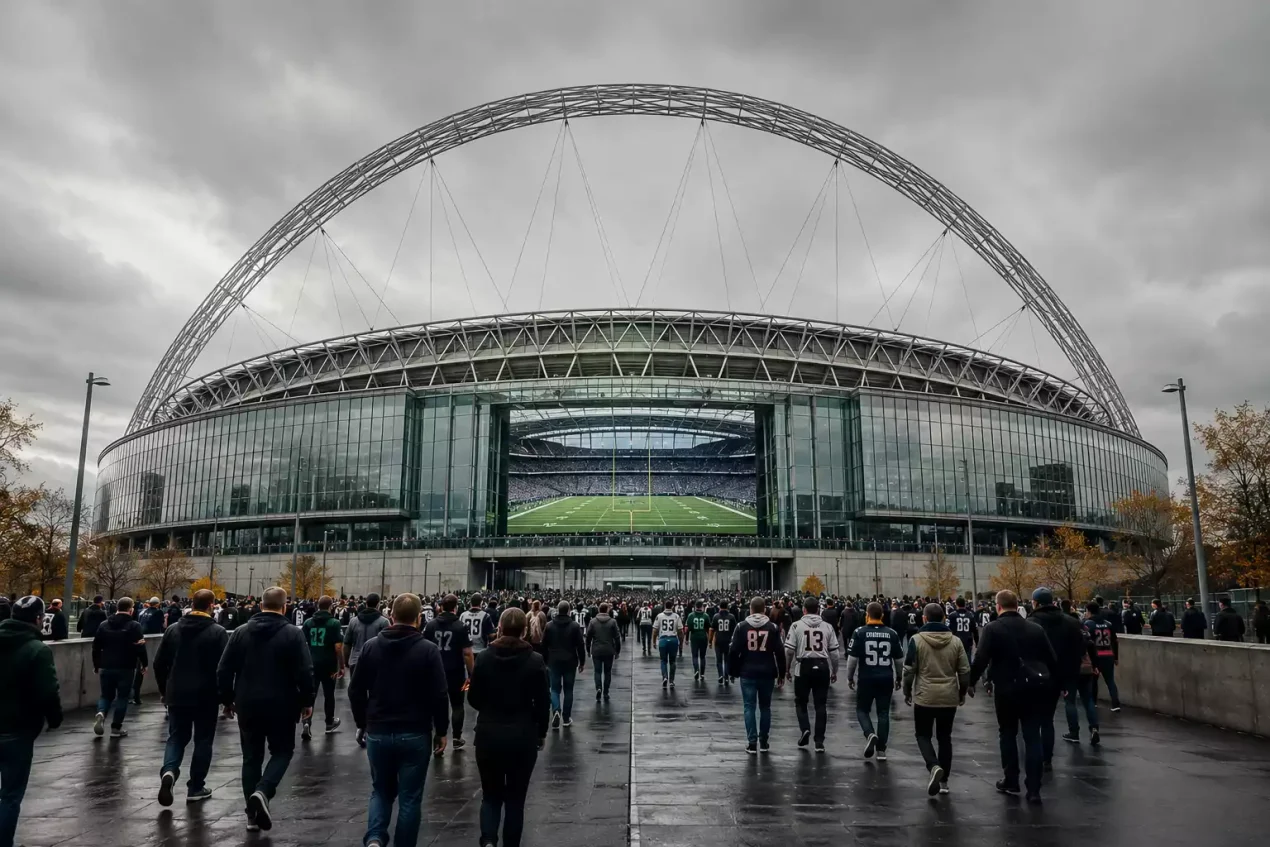
I was at Wembley in October 2024 when the Jaguars played the Patriots in front of 86,651 people — the highest attendance in NFL International Series history at that point. The atmosphere was extraordinary, but what stuck with me from a betting perspective was a conversation I overheard in the queue for overpriced nachos. Two lads behind me were discussing the spread, and one said something along the lines of “the travel thing is a myth, ignore it.” He was wrong, and the result that day reflected exactly why.
NFL London games are not just regular-season fixtures played at a different address. They are logistically distinct events with unique variables that affect how lines are set, how they move, and where value hides. In 2025, the NFL staged a record seven international games: three in London, and one each in Dublin, Berlin, Madrid, and São Paulo. Roger Goodell has publicly stated his ambition to reach 16 international games per season within five years, describing it as the greatest opportunity for growth. For UK punters, this expansion means more games played on your doorstep, more betting angles that the wider market undervalues, and more opportunities to find edge if you understand the dynamics.
Why London Games Create Unique Betting Angles
The Rams versus Jaguars game at Wembley in 2025 drew 86,152 spectators. The Vikings versus Browns London fixture that same year became the most-watched London game on NFL Network, pulling 6.4 million viewers with a peak of 9 million. These are not exhibition matches — they count in the standings, affect playoff positioning, and carry every bit of pressure that a domestic game does. But the conditions surrounding them are fundamentally different, and those differences create inefficiencies in the betting market.
The most significant difference is travel. An NFL team flying from the West Coast to London covers roughly 5,500 miles and crosses eight time zones. East Coast teams have it slightly easier at around 3,500 miles and five time zones, but even that journey is dramatically longer than any domestic NFL trip. US-based sportsbooks, which set the opening lines that UK operators then adjust, tend to account for travel in a generic way — they might shade the line half a point toward the team with the shorter journey. But the effect is more nuanced than that.
Teams that arrive in London early — typically by the Wednesday before a Sunday game — perform differently from teams that fly in on Thursday or Friday. The early arrivals have time to adjust to the time difference and train at local facilities; the late arrivals are often still adjusting when the game kicks off. This information is publicly available through team travel reports and media coverage in the week before the game, but it is rarely reflected in the opening line. By the time the market catches up, the value has already moved.
Crowd composition matters too, though it is harder to quantify. London games do not have a true home-field advantage in the traditional NFL sense — neither team has local fans who create a hostile environment. The crowd is a mix of NFL enthusiasts from across the UK, casual fans attending a spectacle, and corporate guests. The noise level and intensity are high but undirected, which neutralises the 2-3 point home-field advantage that domestic NFL games typically carry. Some sportsbooks adjust for this; others leave the home-field factor in the line as though the game were being played in Jacksonville or Los Angeles.
Travel Fatigue, Jet Lag and How They Affect NFL Lines
Jet lag is not an abstract concept in professional sport — it is a measurable physiological condition that affects reaction time, decision-making, and physical recovery. NFL players are large, heavily conditioned athletes whose bodies are tuned to precise schedules. Disrupting that schedule by five to eight time zones has real effects, and those effects show up in game performance.
West Coast teams travelling to London have historically underperformed expectations in International Series games, particularly in the first half. The 6pm London kickoff translates to 10am Pacific Time, a slot that is two to three hours earlier than any domestic NFL start time. Players accustomed to peaking physically at 1pm or 4pm local time are instead being asked to perform at full intensity during what their internal clocks register as mid-morning. First-half scoring data from London games shows a pattern — not a law, but a pattern — of West Coast teams starting slowly before adjusting as the game progresses.
This creates a specific betting angle on first-half lines. If the market has not fully priced in the jet lag effect for a West Coast team, the first-half spread may be more generous toward the opponent than the full-game spread suggests. I have tracked this angle informally across the past four International Series seasons and found it profitable enough to remain part of my London game playbook, though the sample size is too small for anyone to call it a certainty.
East Coast teams travelling to London face a milder version of the same challenge — a five-hour time difference instead of eight — and their performance data in London games does not show the same first-half underperformance pattern. This suggests the market is already reasonably efficient at pricing East Coast travel, making the biggest inefficiency a West Coast-specific one.
Betting on London Game Day: What UK Punters Should Watch For
More than six million people watched the 2025 London Games via television or online in the UK alone. If you are one of them and you are betting, the game-day environment offers a few advantages that domestic US bettors do not have.
First, you are watching the game live at a reasonable hour. London kickoffs are typically 2.30pm or 6pm UK time, meaning you can watch the full game and bet in-play without staying up until 1am. This matters because live betting on NFL requires sustained attention — tracking drives, monitoring injuries, and reacting to momentum shifts. Doing that at 7pm on a Sunday evening is a very different experience from doing it at midnight.
Second, the UK media coverage of London games is more extensive than coverage of a typical regular-season game. Sky Sports, the BBC, and UK-based NFL journalists provide pre-game analysis, injury updates, and sideline reporting that is tailored to UK audiences. This coverage often surfaces information — weather at the stadium, late-breaking lineup changes, warm-up observations — that US-focused media may not emphasise because they are covering a dozen other games simultaneously.
Third, UK sportsbooks tend to boost promotional activity around London games, offering enhanced odds, free bets, and other incentives. These promotions are usually strongest on the match spread and match winner, which means the London game is often the best-value betting event of any given NFL weekend for UK punters — not because the odds themselves are sharper, but because the promotional overlay improves the effective price.
Pay attention to one more thing on game day: the pitch surface. Wembley and Tottenham Hotspur Stadium both use natural grass, but the turf is prepared differently from NFL-standard surfaces. Players have occasionally commented on the footing, and there have been London games where the surface appeared to affect scrambling quarterbacks and pass rushers more than pocket passers and coverage defenders. It is a marginal factor, but in a tight game it can influence specific prop markets — rushing yards for mobile quarterbacks, sack totals, and similar positional props. If you want to understand how the NFL season structure feeds into these London fixtures, the calendar and scheduling guide breaks down when and why these games fall where they do.
Why London Is the Sharpest Edge on the NFL Calendar
Every sport has markets where casual bettors dominate the action and sharper bettors can find value. For NFL in the UK, London games are that market. The combination of travel variables, neutralised home-field advantage, promotional overlays, and a UK audience that follows these games more closely than any other regular-season fixture creates a set of conditions that reward preparation. If you only bet on three NFL weeks all season, make the London games one of them.
Do NFL London games have different market depth than regular-season games?
Yes. UK sportsbooks typically offer deeper markets on London games than on a standard mid-season NFL fixture. Because these games attract higher betting volume from UK customers, operators expand their prop offerings, add first-half and quarter-specific lines, and often include novelty markets (first scoring play, margin of victory bands) that may not appear for other regular-season games.
How does the home-team designation work for London games?
One team is designated as the ‘home’ team for scheduling and statistical purposes, but there is no genuine home-field advantage because neither team has a local fanbase in London. The designated home team typically wears its home jersey and occupies the home sideline. From a betting perspective, most sharp bettors disregard the home designation entirely and treat London games as neutral-site contests.
This material was created by the GridPunt team.
Related posts

NFL Betting Market Outlook for UK Punters: Trends Shaping 2026 and Beyond

NFL Betting Mistakes to Avoid: Errors That Cost UK Punters Money