NFL Exchange Betting in the UK: How Peer-to-Peer Markets Work
 Available in US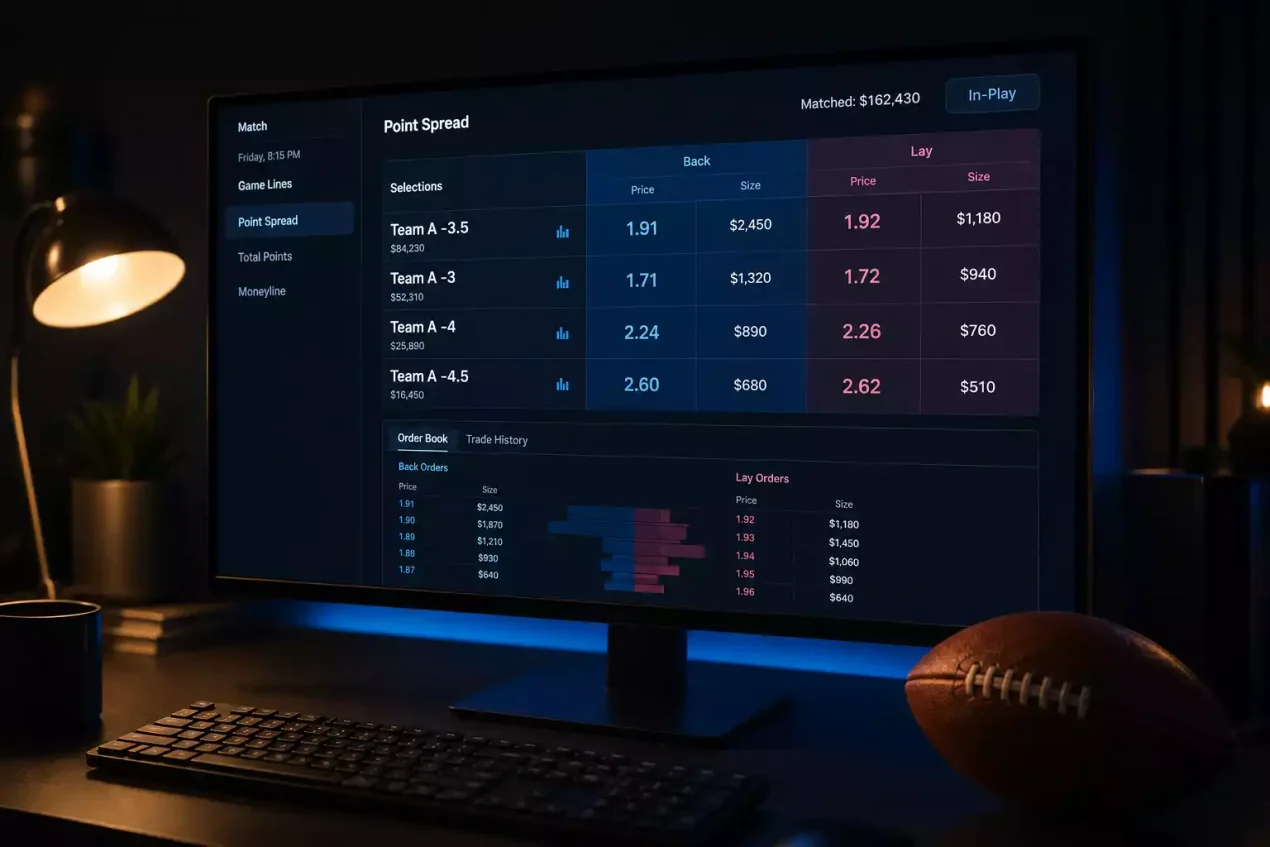
The first time I placed an NFL bet on an exchange rather than a traditional sportsbook, I felt like I had been let behind the counter. Instead of accepting the price a bookmaker offered me, I was setting my own price and waiting for someone on the other side of the market to accept it. The spread on that Sunday Night Football game was -3.5 at the sportsbook; on the exchange, I backed the same team at -3 because someone was willing to lay that number. It was a half-point improvement that cost me nothing except patience — and in NFL betting, half a point is often the difference between a win and a push.
Exchange betting is a peer-to-peer model that eliminates the traditional bookmaker. Instead of betting against the house, you bet against other punters. The exchange facilitates the transaction, matches backers with layers, and takes a commission on winning bets — typically 2-5% depending on the platform. For NFL betting in the UK, exchanges offer structural advantages that are worth understanding, even if the practical challenges of liquidity make them a complement to sportsbooks rather than a replacement.
Exchange vs Bookmaker: Key Differences for NFL Betting
The fundamental difference is pricing. A traditional bookmaker builds a margin into the odds — the overround — which typically runs 4-8% on NFL markets. That overround is the bookmaker’s profit margin, and you pay it on every bet whether you win or lose. On an exchange, there is no overround in the traditional sense. The odds are set by the market — by other bettors — and tend to be closer to the true probability of the outcome. The exchange’s revenue comes from commission on net winnings, not from inflating the odds against you.
The UK sports betting market generates roughly GBP 2.48 billion in annual gross gambling yield, and the bulk of that flows through traditional sportsbooks. Exchanges capture a smaller share, but for the punters who use them, the pricing advantage is measurable. On a standard NFL spread bet priced at 10/11 (1.91) at a sportsbook, the equivalent exchange price might be 1.95 or higher — and the only deduction is the commission on profit if the bet wins.
The second difference is flexibility. On an exchange, you can “back” (bet for an outcome) or “lay” (bet against an outcome). Laying is the inverse of backing — if you lay the Chiefs at -3.5, you are betting that they will not cover the spread. This flexibility allows strategies that are impossible at a traditional sportsbook: you can back a team early in the week and lay them at a shorter price on Sunday if the line has moved in your direction, locking in a profit regardless of the result. This is called “greening up” or “trading a position”, and it is the closest thing to stock trading that sports betting offers.
The third difference is transparency. On an exchange, you can see the full depth of the market — how much money is available at each price level, on both the back and lay sides. This transparency tells you where the market consensus sits and how much liquidity exists. At a sportsbook, you see one price with no indication of how much money is behind it or how it was calculated.
Backing and Laying NFL Outcomes: Mechanics and Commission
Placing a back bet on an exchange works almost identically to placing a bet at a sportsbook: choose your selection, enter your stake, and submit. The difference is that your bet needs to be “matched” — another user must be willing to take the opposite side at your requested price. If no one matches your bet, it sits in the market as an “unmatched” order until someone accepts it or you cancel.
Laying is the more unfamiliar concept for most punters. When you lay an outcome, you are offering odds to someone else. If you lay the Bills to win at 2.10, you are saying “I will pay 2.10 times the backer’s stake if the Bills win, and I collect the backer’s stake if they lose.” Your liability — the amount you could lose — is calculated as (lay odds – 1) multiplied by the backer’s stake. At 2.10 with a GBP 10 back stake, your liability is GBP 11. If the Bills lose, you keep the GBP 10 back stake (minus commission). If they win, you pay out GBP 11.
Commission structures vary by exchange. The standard UK exchange commission on NFL markets runs between 2% and 5% of net winnings. Some platforms offer reduced commission for high-volume users, and promotional periods occasionally drop rates further. The commission replaces the traditional sportsbook’s overround, and for most NFL bet types, the net cost to the bettor is lower on an exchange — provided there is sufficient liquidity to get matched at a competitive price.
One mechanical advantage for NFL live betting: exchanges allow you to trade positions in-play. If you backed a team pre-game and they take a first-quarter lead, you can lay them at shorter odds in-play to lock in profit. This is functionally similar to a sportsbook’s cash-out feature, but with two differences: you set the price yourself (rather than accepting the sportsbook’s cash-out offer), and the exchange’s in-play pricing is market-driven rather than algorithm-driven, which can produce better terms.
NFL Liquidity on UK Exchanges: What to Expect
Liquidity — the amount of money available to match your bet — is the single biggest practical challenge for NFL exchange betting in the UK. NFL is a secondary sport on UK exchanges, which means the available liquidity is far smaller than what you would find on Premier League football or horse racing.
William Hill and Bet365 alone captured more than 50% of click share across UK sports betting search queries in early 2026 — and neither operates an exchange model. The exchange market is dominated by a smaller number of platforms, and their NFL volume is concentrated on specific bet types and events. Pre-game spread and moneyline markets on high-profile Sunday afternoon games typically have adequate liquidity for recreational stakes (GBP 10-50). Midweek games, lower-profile matchups, and player props carry significantly less liquidity, and you may struggle to get a bet matched at your desired price.
Playoff games and the Super Bowl see a spike in NFL exchange liquidity, as casual bettors and traders enter the market for the biggest events. The Super Bowl is often the only NFL fixture where exchange liquidity approaches the levels seen on major Premier League games. For the remaining 99% of the NFL season, exchange betting works best as a targeted tool — use it for specific situations where you want better odds or the ability to trade a position, and use traditional sportsbooks for the bulk of your NFL action.
One tip for managing liquidity challenges: set your orders early. If you want to back the spread on a Sunday game, place your exchange order on Thursday or Friday at the price you want. The order sits in the market and may be matched gradually as other users see it. Waiting until Sunday morning to place an exchange order on a mid-table NFL game is asking for frustration. For a broader look at how price differences between platforms compound over a season, the odds comparison guide covers the mathematics of line shopping across both sportsbooks and exchanges.
A Sharper Tool in a Bigger Toolbox
Exchange betting is not a replacement for sportsbooks in the NFL market — not yet, and probably not for a long time, given the liquidity constraints. But it is a genuinely useful addition to your betting toolkit. Better odds on core markets, the ability to trade positions in-play, and full market transparency give you advantages that a sportsbook-only approach cannot match. The key is knowing when to use each tool: exchanges for price-sensitive pre-game bets on major matchups, sportsbooks for props, niche markets, and anything where exchange liquidity falls short.
Is there enough liquidity on UK exchanges to bet on NFL?
For pre-game spread and moneyline markets on high-profile games, liquidity is usually sufficient for recreational stakes. Lower-profile matchups, player props, and midweek games carry significantly less liquidity. Playoff games and the Super Bowl see the highest NFL exchange volumes. If you plan to use exchanges for NFL, place orders early in the week to increase the chance of getting matched at your desired price.
Can I trade NFL positions in-play on an exchange?
Yes. Exchanges allow you to back and lay the same selection at different prices during a live game, enabling you to lock in profit or cut losses as the market moves. The process is similar to cash out at a traditional sportsbook but gives you more control over the exit price. In-play NFL exchange liquidity is thinner than pre-game, so trading works best on high-volume games where other users are actively participating in the live market.
This material was created by the GridPunt team.
Related posts
NFL Betting Market Outlook for UK Punters: Trends Shaping 2026 and Beyond
NFL Betting Mistakes to Avoid: Errors That Cost UK Punters Money