NFL Same Game Parlay in the UK: How Single-Game Accas Work
 Available in US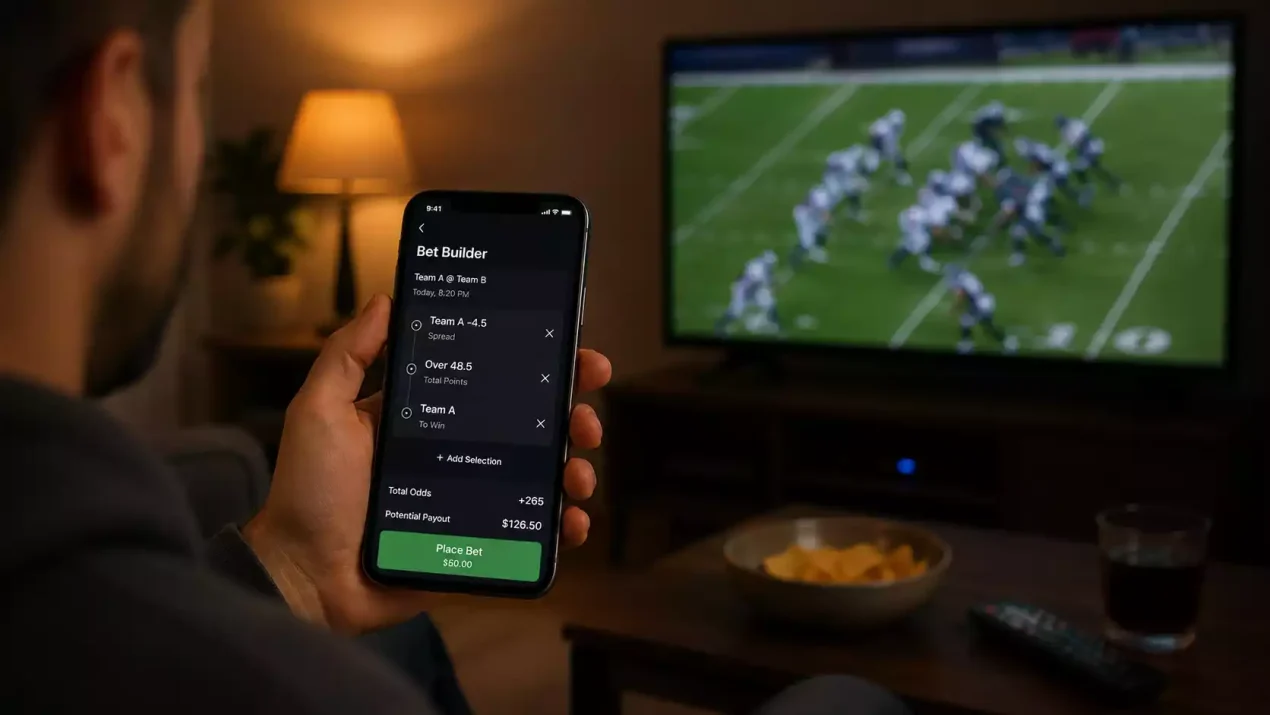
The same game parlay is the most marketed bet type in NFL betting right now — and the one where the gap between perceived value and actual value is widest. Every UK sportsbook pushes its “bet builder” feature during NFL season, showcasing eye-catching combined odds on selections that feel logical: the quarterback throws over 250 yards AND his team wins AND the total goes over 44.5. It looks like a smart combination. The price looks generous. The catch is hidden in the correlation between those legs, and it is eating your edge more than you realise.
I say this as someone who builds same game parlays regularly — not to warn you away from them entirely, but to make sure you understand the mechanics before the mechanics drain your bankroll. The global sports betting market is projected to reach $125.12 billion in 2026, and a growing share of that volume flows through same game products. Sportsbooks are not promoting them this aggressively because they are good for the punter. They are promoting them because the margins are exceptional for the house.
How Same Game Parlays Differ From Standard Accumulators
A standard accumulator combines selections from different games. Each leg is statistically independent — the outcome of the Chiefs versus Bills game has no mathematical connection to the outcome of the Cowboys versus Eagles game. The sportsbook prices each leg individually, multiplies the odds together, and the combined price reflects the true combined probability (minus margin).
A same game parlay combines selections from a single game, and that changes everything. The legs are no longer independent. If you back a team to win and the total to go over, those two outcomes are positively correlated — a team that wins is more likely to have contributed to a high-scoring game. If you back a quarterback to throw over 300 yards and his team to win, again correlated — a quarterback who throws that many yards is probably moving the ball effectively, which increases the team’s win probability.
The sportsbook knows about these correlations. Its pricing engine adjusts the combined odds downward to account for them, which means the displayed price is lower than what you would get by simply multiplying the individual odds. The question is whether the sportsbook’s correlation adjustment is accurate — and in most cases, the evidence suggests they over-adjust, taking a larger cut than the true correlation warrants. That over-adjustment is the house’s edge on same game parlays, and it is significantly larger than the margin on standard single bets or multi-game accumulators.
The Correlation Trap: Why Seemingly Logical Legs Lose Value
The most common same game parlay mistake is building a combination where every leg points in the same direction. Team wins, quarterback throws for a lot of yards, running back scores a touchdown, total goes over — all of these are positively correlated with the same game state (the team is winning, scoring, and dominating). The combined price will look appealing because it is a multi-leg bet, but the effective margin is steep because the sportsbook has priced in the positive correlation between every leg.
Point spread is the preferred bet type for 61% of NFL bettors, with moneyline at 52% and over/under at 47%. Those three bet types also form the backbone of most same game parlays, and combining them within a single game creates dense correlation webs. A team covering a -6.5 spread almost certainly contributed to an over on a middling total. A team winning on the moneyline at short odds almost certainly covered the spread. Each “additional” leg is not truly additional risk — it is a repackaging of the same underlying outcome at a price that makes it look like you are getting paid for independent events.
The subtler version of the correlation trap involves player props. Backing a wide receiver to go over 80 receiving yards and his quarterback to throw over 275 yards sounds like two separate bets, but they share a direct causal link — the wide receiver’s yards are a subset of the quarterback’s total. If the receiver hits 80 yards, the quarterback has already covered a significant portion of his target. The sportsbook adjusts for this, but you are still paying a margin premium on what is essentially one-and-a-half bets dressed up as two.
Where same game parlays offer genuine value is when the legs are negatively correlated or uncorrelated. A defence/special teams touchdown scorer combined with the total going under is negatively correlated — defensive scores often come in low-scoring, scrappy games. An obscure prop (first team to commit a penalty) combined with a rushing yardage line has minimal correlation. These unconventional combinations are harder to construct, less intuitively satisfying, and attract less public money — which is precisely why the sportsbook’s margin on them tends to be thinner.
Building a Profitable NFL Same Game Parlay
If you are going to build same game parlays — and I think they have a place in a balanced NFL betting approach — the framework is straightforward.
Limit your legs. Three is my maximum for a same game parlay. Every leg beyond three multiplies the margin the sportsbook takes, and the correlation adjustments compound in ways that are nearly impossible to calculate without the operator’s proprietary model. Two or three well-chosen legs can produce a meaningful combined price without burying your edge under layers of margin.
Mix directions. Do not stack every leg toward the same game script. If you back the favourite on the spread, pair it with a leg that benefits from a different game state — an under on a specific quarter total, or a prop on the opposing team’s best player. The point is to create a combination where the legs do not all rise and fall together. If they do, you are paying the same game parlay tax for what is functionally a single bet.
Check the price against components. Before placing a same game parlay, note the individual price of each leg. Multiply them together as though they were an independent accumulator. Compare that theoretical combined price to the price the sportsbook is offering on the same game parlay. The difference is the correlation adjustment and margin. If the SGP price is more than 20-25% lower than the theoretical independent price, the sportsbook is taking an aggressive cut and the bet is unlikely to represent value.
Use same game parlays for entertainment, not as your primary strategy. The margins are structurally worse than single bets, and no amount of clever leg selection eliminates that entirely. If you want to build disciplined NFL accumulators across multiple games, the mathematics are more forgiving because the legs are genuinely independent. Same game parlays are the dessert, not the main course.
The Feature Is the Product
Sportsbooks invest millions in their bet builder interfaces because same game parlays are among the highest-margin products they offer. The slick UI, the auto-suggest combinations, the social sharing features — all designed to make building these bets feel effortless and fun. And they are fun, genuinely. Watching a three-leg same game parlay unfold across four quarters is one of the most engaging ways to experience an NFL game. Just make sure the engagement costs you what you intended, not more.
Can I cash out a same game parlay at UK bookmakers?
Most major UK sportsbooks offer cash out on same game parlays, though availability depends on the operator and the specific legs included. Some exotic prop selections may not be eligible for cash out, and cash out pricing on SGPs tends to be less favourable than on standard single bets because the margin is already higher. Check whether your combination is cash-out eligible before placing the bet.
How many legs can I add to an NFL same game parlay?
The maximum varies by operator. Most UK sportsbooks allow between 4 and 12 legs in a same game parlay, though some bet builder tools cap at 6 for NFL. In practice, the correlation adjustments and margin compression make anything beyond 3-4 legs extremely high-margin for the bookmaker. Keeping your SGPs to 2-3 legs gives you the best balance between meaningful combined odds and manageable margin.
This material was created by the GridPunt team.
Related posts
NFL Betting Market Outlook for UK Punters: Trends Shaping 2026 and Beyond
NFL Betting Mistakes to Avoid: Errors That Cost UK Punters Money