NFL Betting Terminology for UK Punters: Every Term You Need to Know
 Available in US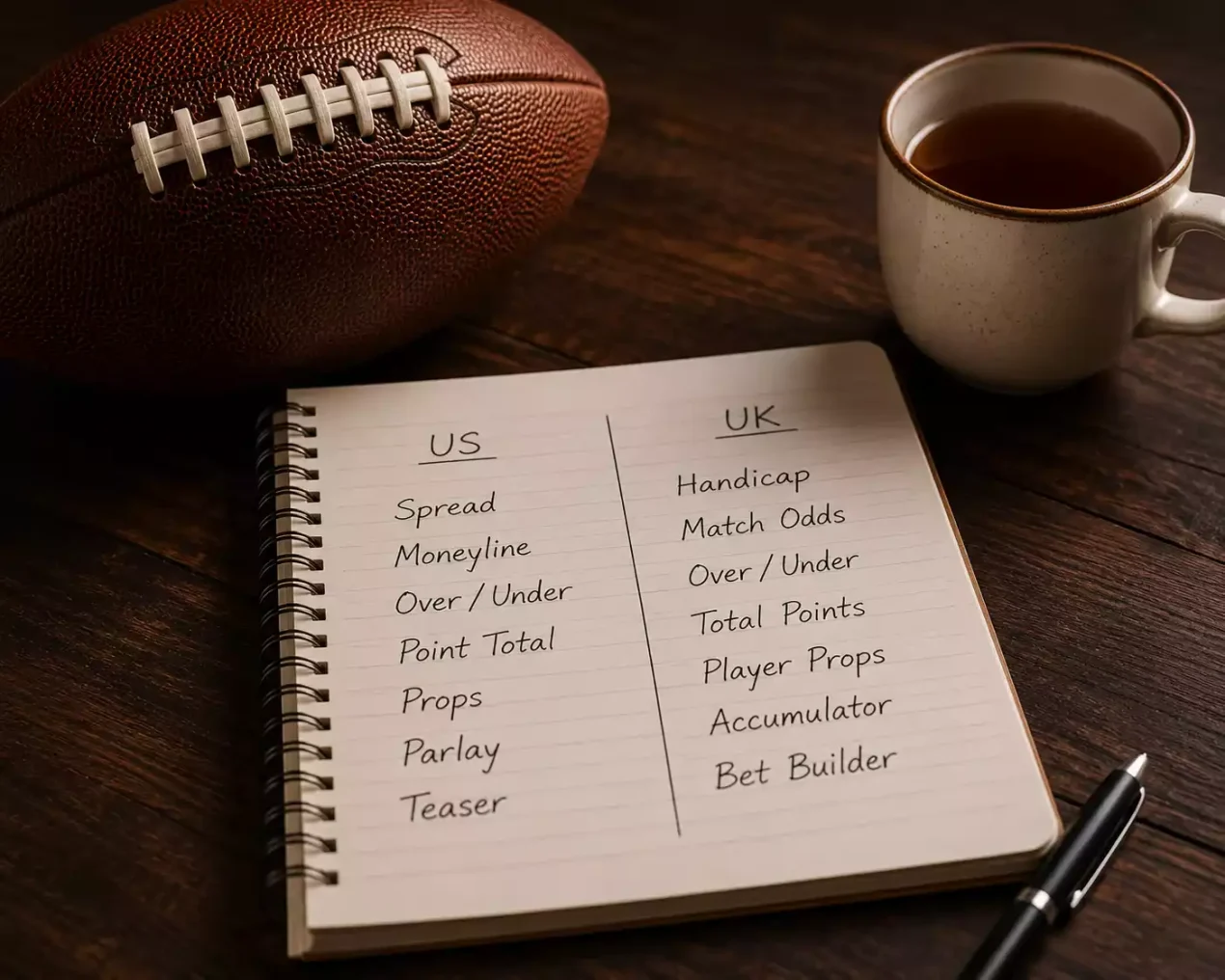
The first time I read an American NFL betting guide, I felt like I was translating a foreign language. “Juice”, “vig”, “chalk”, “dime line” — none of it mapped to anything I knew from years of betting on Premier League football and horse racing. It took me an embarrassingly long time to realise that a “parlay” was just an accumulator and that “covering the spread” meant winning a handicap bet. The concepts were familiar; the vocabulary was not.
That language barrier is real for UK punters entering the NFL betting world. The UK generates roughly 3% of the NFL’s global web traffic, ahead of Germany and every other European market. Around 1.2 million NFL-related searches happen in the UK every month — that is 13% of the volume the Premier League attracts. A growing number of those searchers are punters who understand betting but need a decoder ring for the American terminology that dominates NFL coverage, podcasts, and analytics sites. This is that decoder ring.
US vs UK Betting Terms: A Translation Guide
The gap between American and British betting language is wider than most newcomers expect, and it runs deeper than simple word swaps. The two cultures developed their betting vocabularies independently — the UK through bookmaking shops and horse racing, the US through Las Vegas sportsbooks and point-spread culture — and each carries assumptions that do not always translate cleanly.
Start with the basics. What Americans call a “sportsbook” is what you call a “bookmaker” or “bookie”. A US “bettor” is a UK “punter”. These are straightforward substitutions. The complications begin when you move into bet types.
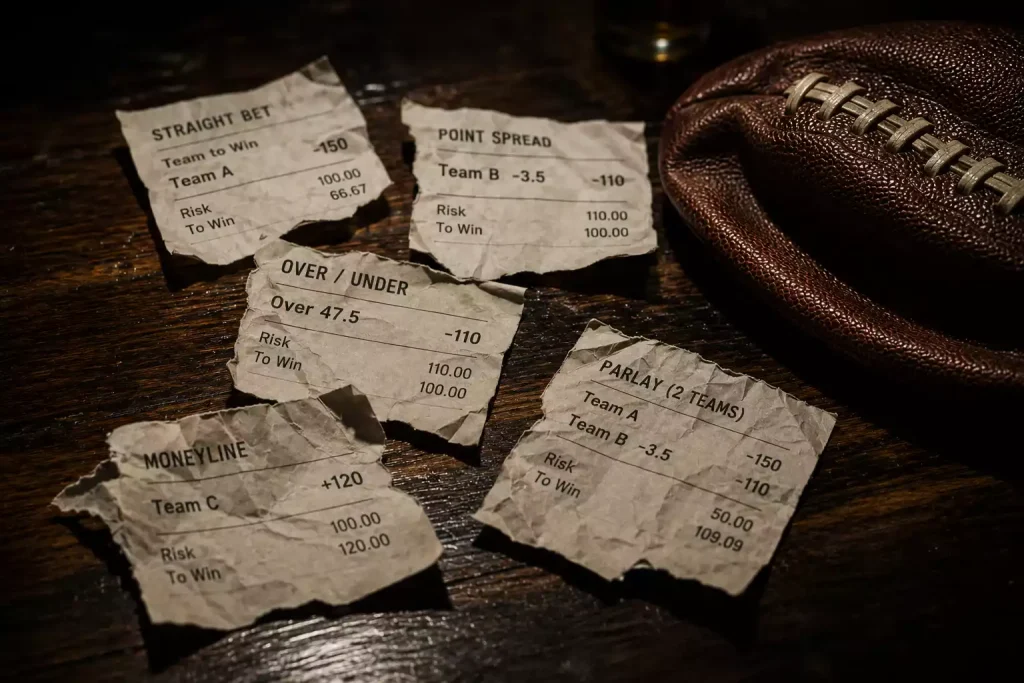
A “parlay” in American English is an “accumulator” or “acca” in the UK. Both mean combining multiple selections into a single bet where all legs must win for the bet to pay out. The mechanics are identical; only the name differs. Similarly, a “same game parlay” (SGP) is what UK sportsbooks call a “bet builder” or “same game multi” — a combination of selections from a single match.
The “moneyline” caused me more confusion than it should have. In the UK, we call this the “match winner” or “to win” market. The bet is identical — pick the team you think will win outright — but the name “moneyline” refers to the way American odds are displayed using plus and minus figures, which is a format rather than a bet type.
“Juice” or “vig” (short for vigorish) is the sportsbook’s margin — what UK punters know as the “overround”. When an American says a bet has “-110 juice”, they mean you risk $110 to win $100, which translates to roughly 10/11 in fractional odds. The concept is identical to the margin built into UK prices; only the framing differs.
A “push” is a draw or void on a spread or totals bet — the result lands exactly on the number, and your stake is returned. UK bookmakers handle pushes the same way, but the term is rarely used on this side of the Atlantic. “Chalk” means the favourite, “dog” means the underdog, and a “lock” is a bet someone considers a certainty (it never is). “Fading” a team means betting against them. “Sharp” money comes from professional bettors; “square” money comes from the public.
One term that trips up UK punters consistently: “units”. In American betting culture, bettors measure stakes and results in “units” rather than currency — one unit is typically 1-2% of your bankroll. A “+3.2 unit” result means a profit of 3.2 times your standard stake. UK punters tend to think in pounds, but the unit system is useful because it normalises results regardless of bankroll size and makes it easier to compare performance across different stake levels.
NFL-Specific Terminology: Football Terms That Affect Your Bets
Beyond general betting language, NFL has its own vocabulary rooted in the sport itself — and these terms show up in market names, prop descriptions, and analytical content that you need to parse accurately to bet effectively.
“Down” is the most fundamental unit of NFL play. Teams have four downs (attempts) to move the ball 10 yards. If they succeed, they get a fresh set of four downs. If they fail, the other team gets the ball. “Third and long” (third down with many yards still needed) is a crucial play type that affects drive success and, by extension, scoring totals. When analysts talk about a team’s “third-down conversion rate”, they are measuring how often the offence sustains drives on these pivotal plays — a metric that correlates with over/under outcomes.
“Red zone” refers to the area inside the opponent’s 20-yard line. “Red zone efficiency” — the percentage of red zone trips that result in a touchdown rather than a field goal — is a key stat for totals and scoring props. A team that scores touchdowns on 65% of red zone trips will push game totals higher than a team that settles for field goals 50% of the time, even if both teams move the ball equally well between the 20s.
“Turnover” covers interceptions (a pass caught by the defence) and fumbles (the ball carrier loses possession). “Turnover margin” — the difference between turnovers forced and turnovers committed — is one of the strongest single-game predictors of victory. It appears in some prop markets (“total turnovers in game”) and indirectly affects every spread and moneyline price.
“Snap count” is how many plays a player participates in, expressed as a percentage of total team plays. If a running back’s snap count drops from 75% to 50%, his rushing prop lines should drop accordingly — but the market does not always adjust immediately, especially at UK sportsbooks where NFL expertise is thinner than on domestic markets.
“Bye week” is the scheduled week off that every team receives once during the 18-week season. “Post-bye” teams have had two weeks to prepare, which historically provides a small but measurable edge. The term shows up when analysts discuss scheduling advantages and “look-ahead spots” — games where a team may be mentally focused on a high-profile matchup the following week rather than the current one.
Odds Format Quick Reference: American, Fractional and Decimal
Three odds formats circulate in NFL betting content, and you need to be comfortable moving between them. UK sportsbooks default to fractional, American sources use the plus/minus system, and decimal sits somewhere in between as the format most popular in continental Europe and among exchange bettors.
Fractional odds show profit relative to stake. At 5/2, you profit GBP 5 for every GBP 2 staked (plus your stake back). At 10/11, you profit GBP 10 for every GBP 11 staked. Fractional is intuitive for horse racing and football punters but becomes awkward with NFL prices because spreads are typically priced at 10/11 — a fraction that does not simplify neatly.
American odds use a baseline of $100. Positive numbers (+200) show how much you profit on a $100 stake. Negative numbers (-150) show how much you must stake to profit $100. The minus figure is always the favourite; the plus figure is the underdog. Converting to fractional: +200 equals 2/1; -150 equals 2/3. The formula is not difficult once you have done it a few times, but for quick reference, most sportsbook apps let you toggle between formats in the settings.
Decimal odds are the simplest mathematically. They show the total return per unit staked, including the stake. Decimal 3.00 means you get GBP 3 back for every GBP 1 wagered (GBP 2 profit plus GBP 1 stake). Decimal 1.91 — the standard NFL spread price — means a GBP 10 bet returns GBP 19.10 if it wins. If you are reading American NFL analysis and need to quickly assess value, converting to decimal and comparing against your sportsbook’s price is the fastest method. For a practical walkthrough of placing your first bet using these formats, the beginner’s guide to NFL betting in the UK covers the process step by step.
The Language Gets Easier — the Bets Stay Hard
Learning the vocabulary is the easiest part of NFL betting. Once “parlay” clicks as “accumulator” and “juice” registers as “overround”, the language barrier dissolves and you can engage with the vast library of American NFL analysis on equal footing with US bettors. The hard part — identifying value, managing your bankroll, and maintaining discipline across an 18-week season — requires the same skills regardless of which words you use to describe them.
Why do US sportsbooks display NFL odds with plus and minus signs?
The American odds format uses a $100 baseline. A minus sign (-150) tells you how much you must stake to profit $100; a plus sign (+200) tells you how much you profit on a $100 stake. This system evolved from Las Vegas sportsbook culture and remains the standard in the US. UK sportsbooks use fractional odds by default, but most allow you to switch to American or decimal format in the app settings.
What does covering the spread mean?
Covering the spread means winning a point spread (handicap) bet. If a team is favoured by 7 points (-7), they cover the spread by winning by more than 7. If the underdog is +7, they cover by losing by fewer than 7 or winning outright. The term is used almost exclusively in American sports betting. In UK terminology, covering the spread is equivalent to winning a handicap bet.
This material was created by the GridPunt team.
Related posts
NFL Betting Market Outlook for UK Punters: Trends Shaping 2026 and Beyond
NFL Betting Mistakes to Avoid: Errors That Cost UK Punters Money