
NFL Betting Bankroll Management: Staking Plans That Protect Your Balance
 Available in US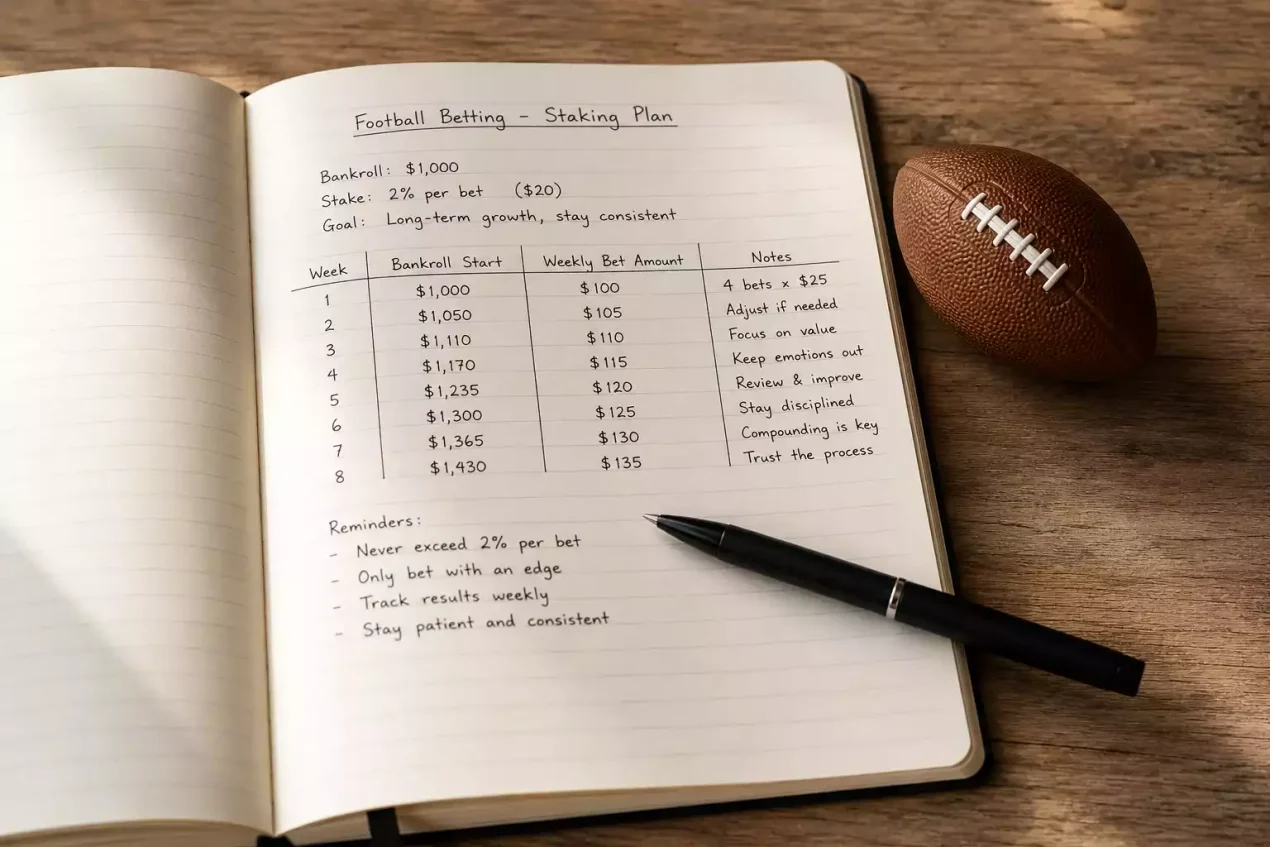
I have watched sharp NFL bettors with genuine analytical edges go broke because they staked too aggressively, and I have watched mediocre handicappers survive entire seasons because they sized their bets properly. The edge matters, but the staking plan is what determines whether you are still standing in February. If you have ever had a winning week wiped out by a single over-sized losing bet, or if you have ever reached Week 12 with your bankroll so depleted that you could not capitalise on the playoff markets you had been waiting for all season, this is the article that fixes that.
Bankroll management is unsexy. It does not produce highlight-reel wins or social media screenshots. But it is the single most reliable predictor of whether a punter’s NFL season ends in profit or frustration — and it is the one area where discipline costs nothing and pays compound dividends.
Setting Your NFL Betting Bankroll: How Much Is Enough?
Your bankroll is the total amount of money you have set aside exclusively for NFL betting. It is not your monthly disposable income, not your savings, and not money you might need for rent or bills. It is a ring-fenced sum that you can lose entirely without affecting your life. That sounds dramatic, but the distinction is critical: if losing your bankroll would cause financial stress, the bankroll is too large.
Around 10% of UK adults actively bet on sports online, and the affordability checks introduced by the UKGC in February 2025 — triggered at GBP 150 in net deposits over 30 days — reinforce the principle that betting should be proportionate to income. Setting a bankroll that sits comfortably below the threshold where your sportsbook starts asking questions is not just regulatory common sense; it is a practical way to keep your betting activity clean and uninterrupted.
For recreational NFL bettors, a seasonal bankroll of GBP 200 to GBP 500 is a reasonable starting point. The NFL regular season runs 18 weeks, plus four rounds of playoffs and the Super Bowl — roughly 23 weeks of betting opportunities. A GBP 300 bankroll divided across 23 weeks gives you approximately GBP 13 per week to work with, which is enough for two or three carefully chosen bets per gameweek at GBP 4-5 each. That may sound modest, but modest stakes with disciplined selection produce better long-term results than large stakes with undisciplined selection every time.
The cardinal rule: never top up a depleted bankroll mid-season with money you had not originally allocated. If your bankroll is gone by Week 10, your season is over. Accept it, analyse what went wrong, and start fresh next year with a better approach. Chasing losses with fresh deposits is the fastest route to financial harm.
Flat Staking, Percentage Staking and Kelly Criterion for NFL
Once your bankroll is set, you need a staking method — a rule that determines how much of your bankroll goes on each bet. Three approaches dominate, and each has distinct characteristics suited to different temperaments and skill levels.
Flat staking is the simplest: bet the same amount on every selection, regardless of confidence level. If your standard stake is 2% of your starting bankroll (GBP 6 on a GBP 300 bankroll), every NFL bet is GBP 6. The advantage is simplicity and emotional discipline — you cannot talk yourself into a larger stake on a “sure thing” that turns out not to be. The disadvantage is that it does not capitalise on situations where your edge is larger than usual. For most recreational NFL bettors, flat staking is the best starting point because it eliminates the most common source of bankroll destruction: variable staking driven by emotion rather than analysis.
Percentage staking adjusts your bet size to a fixed percentage of your current bankroll. At 3% per bet, a GBP 300 bankroll produces a GBP 9 first bet. If you win and your bankroll grows to GBP 310, your next bet is GBP 9.30. If you lose and the bankroll drops to GBP 291, the next bet is GBP 8.73. The system automatically scales your exposure — stakes grow when you are winning and shrink when you are losing, which protects against ruin during cold streaks and accelerates growth during hot ones. The percentage you choose matters: 1-2% is conservative, 3-5% is moderate, and anything above 5% is aggressive enough to cause significant bankroll volatility.
The Kelly Criterion is a mathematical formula that calculates the optimal stake based on your perceived edge and the odds offered. The formula is: stake = (edge / odds) as a percentage of bankroll, where edge is the difference between your estimated probability and the implied probability of the odds. Kelly produces the theoretically fastest bankroll growth, but it requires accurate probability estimates — which is the hard part. Overestimating your edge even slightly leads to over-staking, and over-staking leads to ruin. Most experienced bettors who use Kelly apply a “fractional Kelly” approach — typically half or quarter Kelly — to account for the uncertainty in their own probability estimates. Unless you have a quantified, track-recorded edge on NFL markets, full Kelly is too aggressive for practical use.
Managing Your Bankroll Across an 18-Week NFL Season
The NFL season has a rhythm that affects bankroll management in ways other sports do not. The regular season is 18 weeks with each team playing 17 games, followed by playoffs that compress from 14 teams to one over four weekends. Your bankroll plan should account for this structure.
Early season (Weeks 1-4) is the period of greatest uncertainty. Rosters have changed, coaching schemes are being installed, and the market has not yet calibrated to teams’ true ability. Staking conservatively in the early weeks — perhaps 1.5% per bet instead of your standard 2-3% — preserves capital for the period when information quality improves. Many profitable NFL bettors report their best results from Week 5 onward, once the sample of games is large enough to separate signal from noise.
Mid-season (Weeks 5-14) is when your analytical edge should be sharpest. Performance data has accumulated, injury patterns are established, and the market is pricing based on real results rather than preseason projections. This is the window to bet at your full staking level, with the discipline to remain selective rather than increasing volume just because you feel more confident.
Late season and playoffs (Weeks 15 onward) introduce new variables — teams resting starters, playoff seeding implications, and the heightened public interest that distorts lines during the postseason. AGA President Bill Miller has described how the legal betting industry encourages fans to have a game plan before placing a bet, ensuring the experience remains enjoyable regardless of the outcome. That advice applies with extra force during the playoffs, when the emotional intensity of the games can override the staking discipline you maintained all season. Stick to your plan. The playoffs are not the time to double your stakes because it “feels bigger”.
Review your bankroll position at the midpoint of the season (around Week 9) and at the start of the playoffs. If your bankroll has grown, you may choose to withdraw some profits and continue with a smaller working balance — locking in gains while keeping the betting experience alive. If your bankroll has shrunk, reduce your stake percentage or take a week off to reassess your approach. For a detailed framework on the tools that help you stay in control throughout the season, the responsible gambling guide covers deposit limits, session timers, and self-exclusion options.
The Plan Is the Point
Bankroll management is not a strategy that wins you bets. It is the infrastructure that ensures winning bets translate into actual profit and losing streaks do not translate into financial harm. Set your bankroll before the season starts. Choose a staking method and commit to it. Review mid-season and adjust down if needed — never up in the heat of a losing run. The punters who survive the longest are not the ones with the best picks. They are the ones who never risk enough on any single bet to knock themselves out of the game.
What percentage of my bankroll should I risk per NFL bet?
Most bankroll management frameworks recommend 1-3% of your total bankroll per bet for recreational bettors. At 2% per bet on a GBP 300 bankroll, each stake is GBP 6. This level allows you to absorb a losing streak of 10-15 bets without significant bankroll damage. More aggressive staking (4-5%) accelerates both growth and drawdown, and is only appropriate if you have a documented, positive track record over multiple NFL seasons.
How do affordability checks affect my bankroll planning?
The UKGC requires operators to conduct enhanced financial checks when your net deposits exceed GBP 150 over 30 days at a single sportsbook. This threshold does not limit your betting, but it may trigger requests for financial documentation. Planning your bankroll deposits to stay below this threshold — or being prepared to respond promptly to documentation requests — keeps your betting experience smooth. Spreading your bankroll across two or three sportsbooks can also help manage the threshold at each individual operator.
This material was created by the GridPunt team.
Related posts

NFL Betting Market Outlook for UK Punters: Trends Shaping 2026 and Beyond

NFL Betting Mistakes to Avoid: Errors That Cost UK Punters Money